Hydroponic nutrients are a complete water-soluble mineral solution that supplies every element a plant needs to grow. They replace everything soil normally provides, from the nitrogen driving leaf growth to the trace iron and manganese plants need at the cellular level. For most beginners growing herbs or lettuce, a one-part powder like General Hydroponics MaxiGro ($15–$25/lb) covers the whole crop cycle. If you want the lowest cost per gallon, Jack's 321 or the Masterblend 4-18-38 kit ($25–$40) drop you to roughly $0.02–$0.07 per gallon once you learn the three-part mixing order. Get the concentration and pH right and plants grow faster than in dirt. Get it wrong and they show deficiency symptoms within days, because there is no soil buffer to compensate.
I'm Carl, and I curate this blog. I'm not a chemist or a commercial grower. To put this guide together I read through the Penn State and University of Minnesota Extension material on controlled-environment agriculture, checked what each nutrient brand recommends on its own bottles, and cross-referenced a handful of peer-reviewed plant nutrition papers to catch any conflicts. Every number below links to its source. Prices were verified in July 2026, but nutrient pricing tracks fertilizer commodity costs and moves month to month, so double-check with retailers before you buy.
What are hydroponic nutrients?
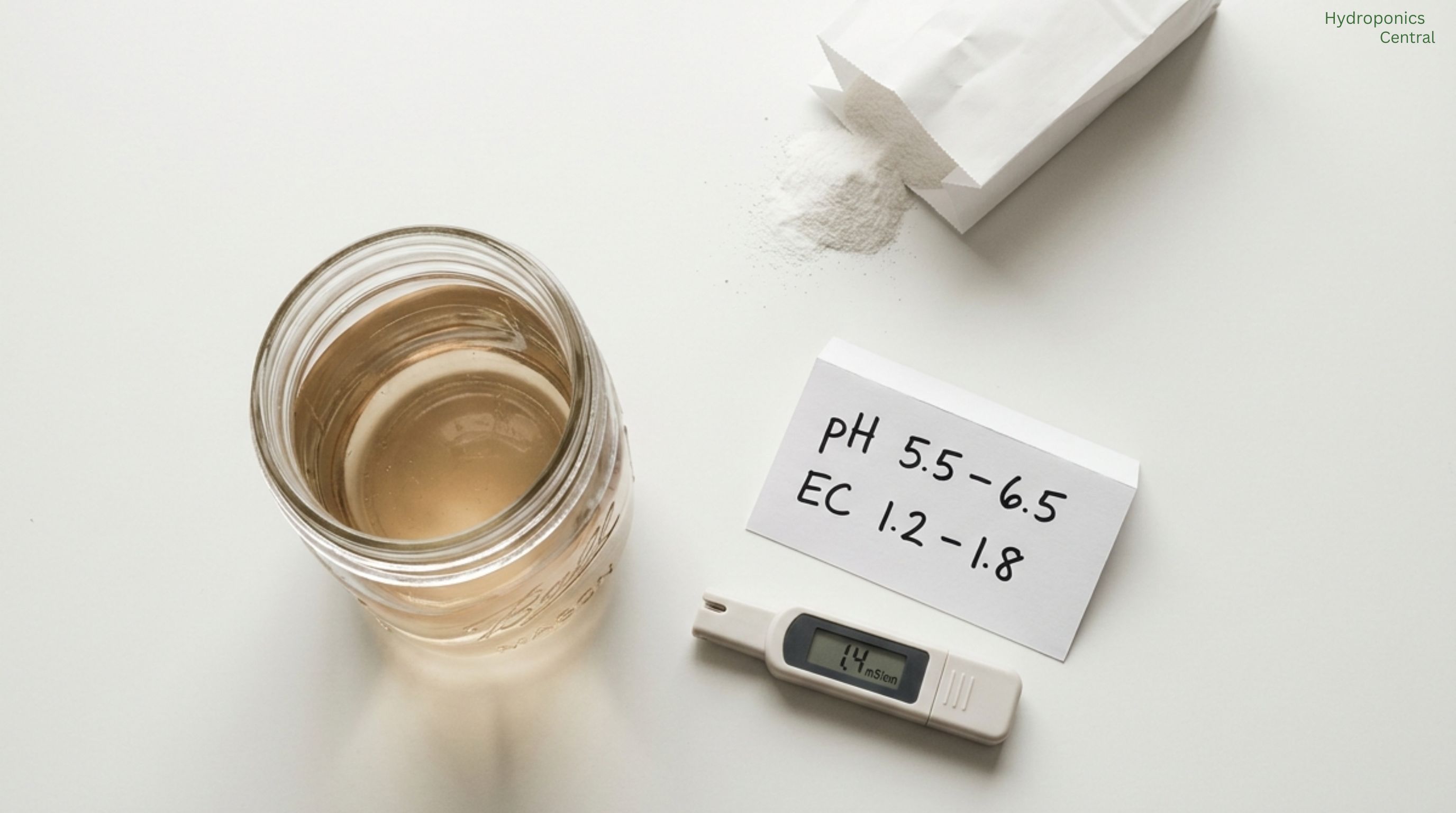
Hydroponic nutrients are water-soluble mineral salts that supply every element a plant needs to grow, dissolved directly into the reservoir water. In soil, plants extract nutrients from decaying organic matter and mineral particles over weeks, with billions of microorganisms acting as a biological buffer that replenishes what's consumed. In a hydroponic system, there is no buffer. Every element must be present in the water, in the correct chemical form, at the right concentration, every time the roots drink.
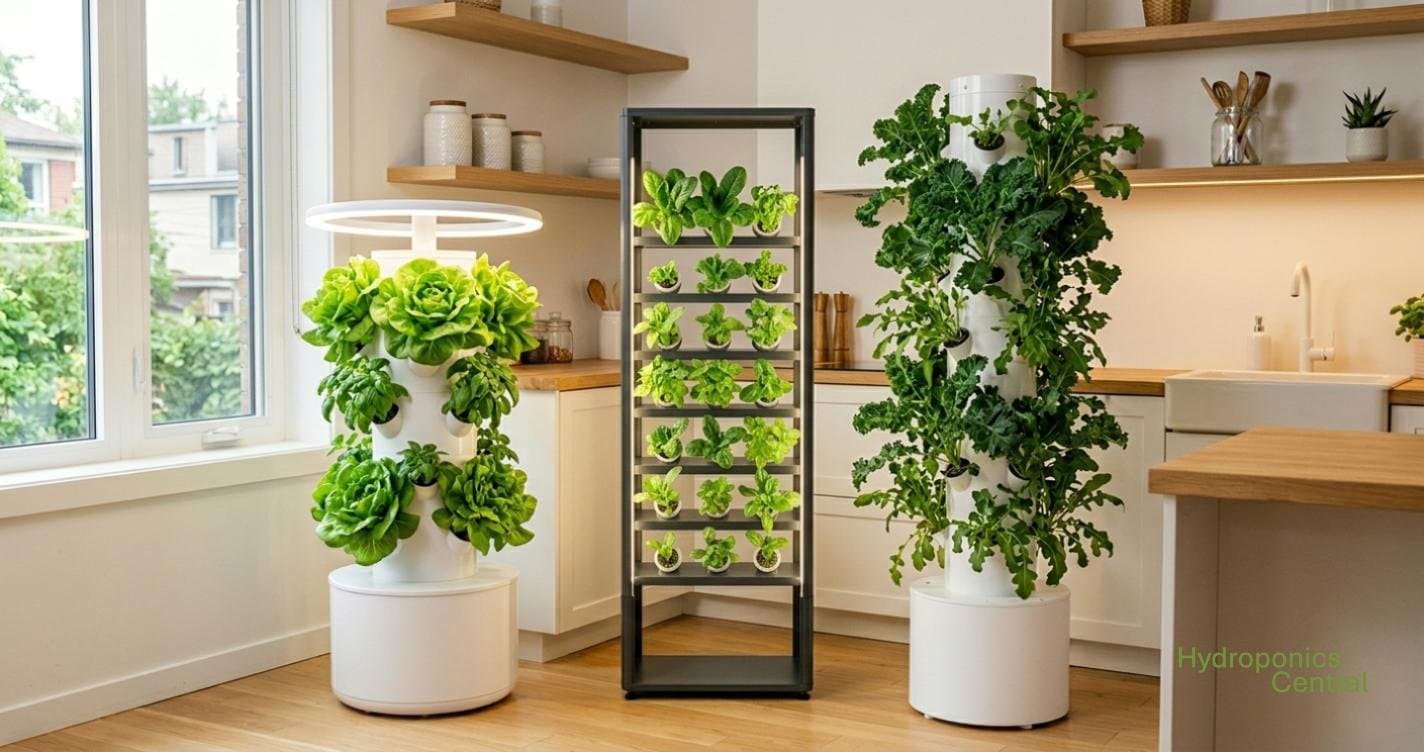
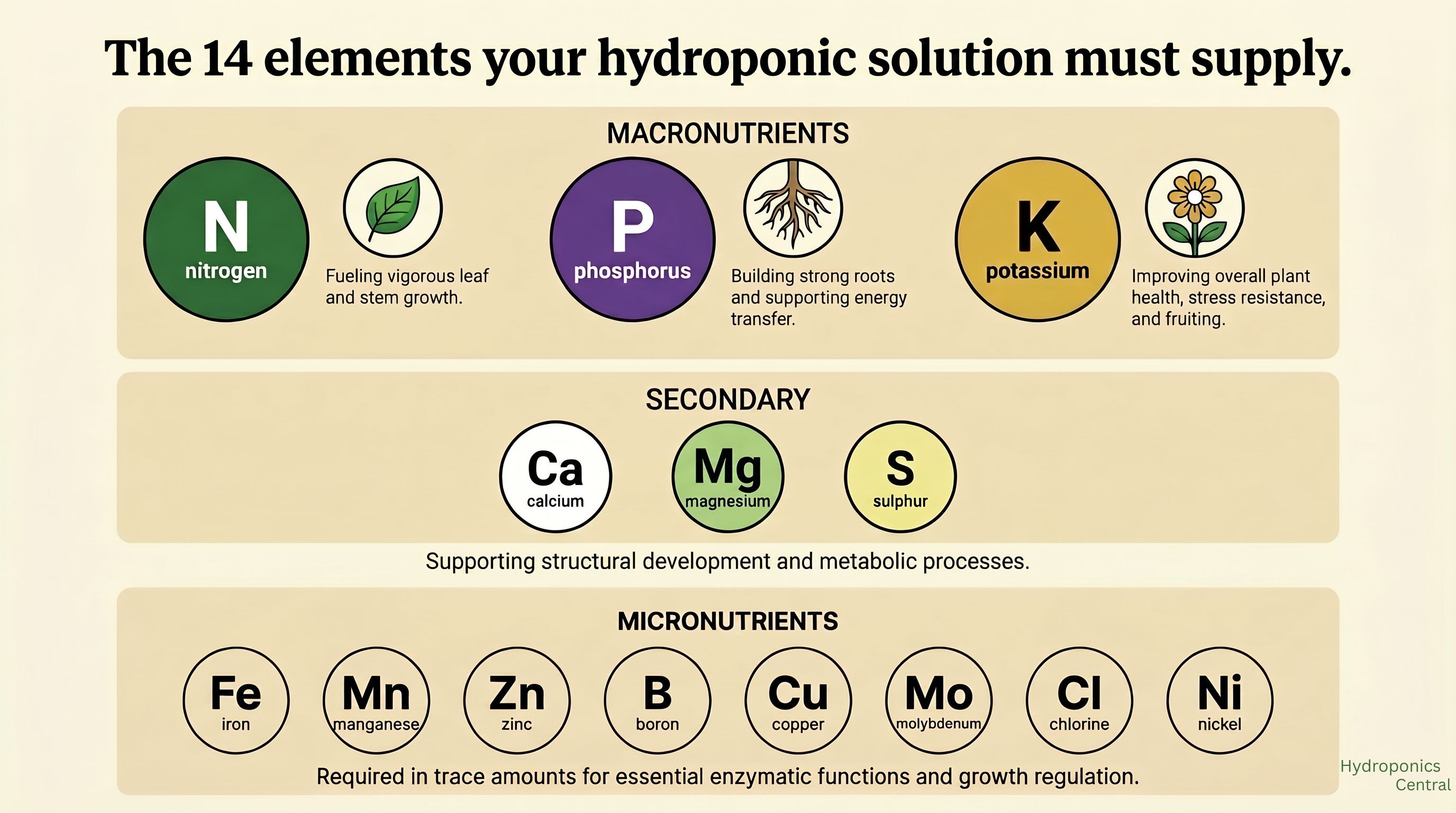
Plants require 17 essential nutrients, per Penn State Extension. Three come from air and water (carbon, hydrogen, oxygen). The remaining 14 must come from your nutrient solution. Short-season, non-fruiting crops like lettuce and herbs are the best beginner choices because their nutrient demands are simpler and more forgiving than fruiting crops. If you're still picking a system, the indoor hydroponic garden guide covers the setups that pair best with the nutrients below, and the hydroponic herb garden walkthrough has the specific EC targets per crop.
Primary macronutrients (needed in the largest quantities):
- Nitrogen (N): drives vegetative growth, leaf production, and chlorophyll synthesis
- Phosphorus (P): root development, flowering, and energy transfer
- Potassium (K): water movement, disease resistance, and fruit quality
Secondary macronutrients (needed in moderate quantities):
- Calcium (Ca): cell wall structure. Deficiency causes tip burn in lettuce and blossom end rot in tomatoes.
- Magnesium (Mg): the central atom of chlorophyll. Deficiency shows as yellowing between leaf veins while veins stay green (interveinal chlorosis).
- Sulfur (S): enzyme function and protein synthesis.
Micronutrients (needed in trace amounts but still essential):
Iron, manganese, zinc, copper, boron, molybdenum, chlorine, and nickel. These appear in tiny concentrations but a deficiency in any one of them stops plant growth. That's why "complete" nutrient formulas matter. A partial formula that omits micronutrients will produce plants that look normal until a deficiency appears weeks in.
Why hydroponics demands complete nutrition
Hydroponics has no biological buffer. Ohio State Extension counts 100 million to 1 billion bacteria per teaspoon of productive soil constantly mineralising organic matter, so a slightly iron-deficient soil today often self-corrects tomorrow. In a reservoir, none of that exists. If calcium isn't in the water, your plant has none. If iron is at the wrong pH, it chemically locks out even though it's dissolved. This is also why nutrient solutions go imbalanced over time. Plants pull N, P, and K at different rates by growth stage, so after two weeks of top-ups, what's left is whatever the plant didn't consume, not a balanced mix. That's the case for a full reservoir change every 7–14 days. Overdue reservoirs also warm and de-oxygenate, which is the entry condition for Pythium and root rot.
Liquid nutrients vs powder nutrients
Powder hydroponic nutrients cost 50–80% less per gallon than liquid equivalents and stay stable on the shelf for 3–5 years sealed, while liquid nutrients are faster to measure and easier to find in local garden centres. Liquid wins for small home systems of one to three plants. Powder wins the moment you scale past ten.
Liquid vs powder hydroponic nutrients, compared across ease of use, per-gallon cost, shelf life, availability, and portability.
Practical verdict: for one to three Kratky jars or a small countertop system, liquid is fine. The per-gallon premium is small at that scale. Past about ten plants, powder pays you back in weeks.
Single-part vs multi-part nutrient systems
Single-part products (MaxiGro, MaxiBloom) contain every essential element in a fixed ratio. One scoop, done. Multi-part systems (Flora Series, Jack's, Masterblend) split nutrients across two or three components so you can shift the N:P:K ratio between growth stages. Multi-part also exists because some salts can't coexist in concentrated form without precipitating. That's the same chemistry that forces calcium nitrate into its own stock tank.
For a first system growing herbs or lettuce, go single-part. The fixed ratio is engineered for steady growth without stage adjustments and removes one of the biggest sources of beginner error. Switch to multi-part when you start fruiting crops or want to deliberately push specific growth stages.
The best hydroponic nutrients by budget
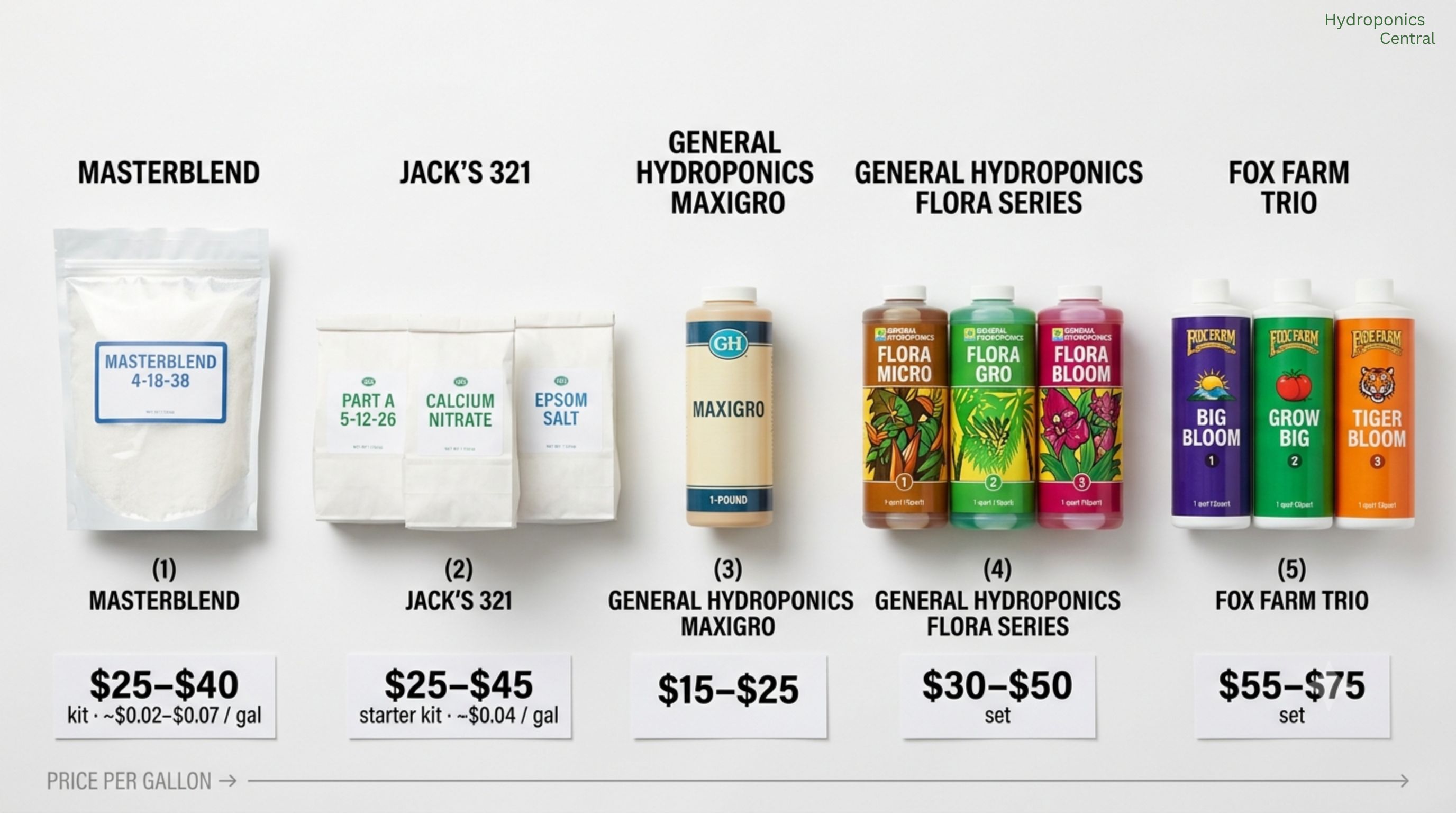
For most beginners, the best hydroponic nutrient is General Hydroponics MaxiGro ($15–$25/lb). It's one powder with no multi-part ratios, and one product covers the whole crop cycle for herbs and leafy greens. For the lowest cost per gallon, Jack's 321 or the Masterblend 4-18-38 kit ($25–$40) drop you to $0.02–$0.07 per gallon. For fruiting crops that need stage-specific control, the Flora Series 3-part liquid ($30–$50) is the industry standard. The products below are the ones most consistently used by home growers, and the ones university extension hydroponic programmes reference most often. Prices are approximate. Confirm with retailers before buying.
Budget option: Masterblend 4-18-38 kit ($25–$40 for a complete 1 lb starter kit)
Masterblend is a commercial-grade powder system that became popular with home growers because of its exceptionally low cost per gallon. The full kit requires three components: Masterblend 4-18-38, calcium nitrate, and Epsom salt (magnesium sulfate). Each is available separately, and starter kits bundle all three.
Mixing ratio (per gallon of water):
- 2.4g Masterblend 4-18-38: add first, stir until fully dissolved
- 1.2g Epsom salt (magnesium sulfate): add second, stir until dissolved
- 2.4g calcium nitrate: add LAST, stir until dissolved
The order is not optional. Penn State Extension is direct about why. "Calcium should be in a different tank than phosphates and sulfates", because concentrated calcium reacts with both, dropping calcium sulfate and calcium phosphate out of solution as a white sludge that takes calcium and phosphorus with it. The per-gallon mixing rule is the home-scale version of the same principle. Each salt has to fully dissolve in the working volume before the next one goes in. If you make stock concentrates, calcium nitrate gets its own bottle and the other two share one. Never combine concentrates directly.
The resulting solution costs roughly $0.07 per gallon, which is 4–8 times cheaper than comparable liquid systems.
Best for: Growers who want the lowest long-term cost and will learn the three-step mixing process. Not ideal if you want one bottle and done.
Budget option: Jack's 321 ($25–$45 for a 2 lb starter kit)
Jack's 321 is the other dry three-part system home growers reach for, and it's increasingly preferred over Masterblend because the included Hydro 5-12-26 (Part A) is engineered specifically for hydroponic solubility rather than being a repurposed greenhouse formula. The "321" refers to the per-gallon ratio: 3g Part A, 2g calcium nitrate (Part B), 1g Epsom salt. That's easier to remember than the Masterblend ratios.
Mixing rule: dissolve each component fully into the water one at a time, in the same A → Epsom → calcium-nitrate-last order. Per-gallon cost lands at roughly $0.02–$0.03, which is the cheapest mainstream option once you're at scale.
Best for: Growers running ten or more plants who want commercial-grade results at the lowest per-gallon cost. The 321 ratio is also the easiest dry recipe to memorise.
Mid-range: General Hydroponics MaxiGro and MaxiBloom ($15–$25 per pound)
One-part powder nutrients from General Hydroponics. MaxiGro (NPK 6-15-36) is formulated for vegetative growth, and MaxiBloom (NPK 5-15-14) for flowering and fruiting. Switch products when plants transition from leaves to fruit.
Mixing rate: 7g per gallon as a starting point, then adjust EC up or down by adding more product or diluting with water.
Best for: Beginners who want one scoop and no order-of-operations. The single easiest hydroponic nutrient product to start with.
Mid-range: General Hydroponics Flora Series 3-part ($30–$50 for a quart set of all three bottles)
The Flora Series (FloraMicro, FloraGro, FloraBloom) is the industry-standard 3-part liquid system. The ability to adjust ratios between the three bottles (more nitrogen during vegetative growth, more phosphorus during flowering) is the main advantage over single-part systems. Add FloraMicro to the water first, stir, then FloraGro, then FloraBloom. Reversing the order in concentrated form risks the same calcium-phosphate precipitation Penn State warns about in dry systems.
Sample mixing ratio (vegetative phase, per gallon):
- 5ml FloraMicro
- 10ml FloraGro
- 5ml FloraBloom
Honest take: for herbs and lettuce, the Flora Series is overengineered. You'll use the same ratio for the entire crop cycle and never touch the stage adjustment that's supposed to justify the three bottles. Three-part really earns its keep on tomatoes, peppers, and cucumbers.
Premium: Fox Farm Trio ($55–$75 for a quart set)
Fox Farm (Big Bloom, Grow Big, Tiger Bloom) is a 3-part liquid with an organic base. The feed schedule is more complex, and per-gallon cost is the highest of these options. The performance delta over Flora Series doesn't justify the price gap unless organic inputs are specifically what you want.
Organic vs synthetic nutrients in hydroponics
For pure hydroponics, synthetic mineral-salt nutrients (MaxiGro, Jack's, Masterblend, Flora Series) are the correct choice. They dissolve completely, deliver a precise nutrient profile, and don't feed the bacterial blooms that clog pumps and starve roots of oxygen. Organic inputs like fish emulsion or seaweed extract work in soil because microbes break them down over weeks, but a sterile reservoir has none of that biology. Most commercial hydroponic nutrients are synthetic mineral salts formulated for immediate water solubility. Organic inputs (seaweed extract, fish emulsion, worm-casting tea) are technically usable but introduce undissolved particles that clog drip emitters, feed bacterial films on reservoir walls, and produce unpredictable concentration and pH. Most also lack a complete micronutrient profile without supplementation.
If organic matters to you, coco coir or soil-based systems are a better fit. For hydroponics, start synthetic and add beneficial bacteria like Hydroguard once the fundamentals are stable. That's the standard prevention playbook.
EC and PPM for hydroponics
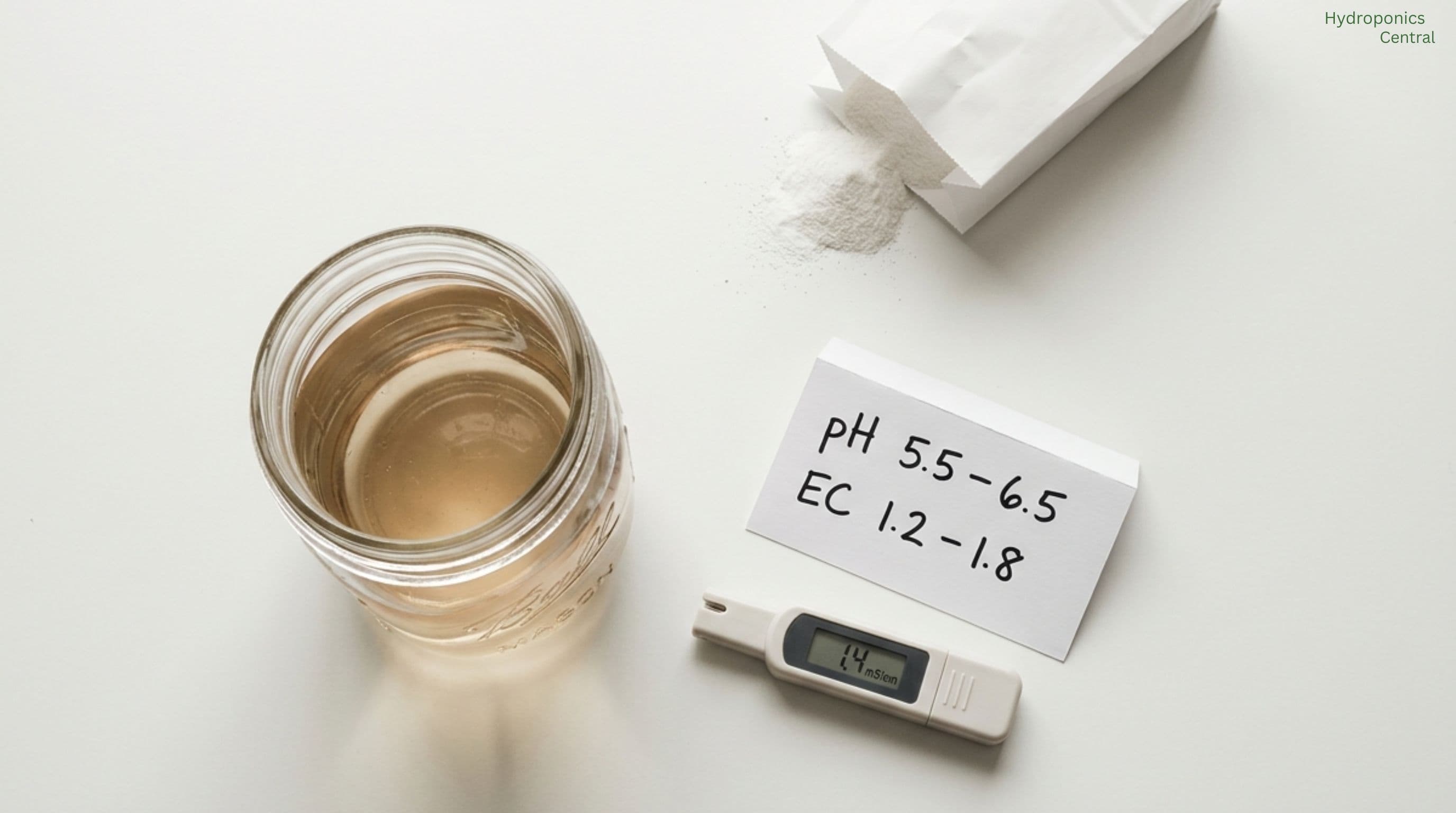
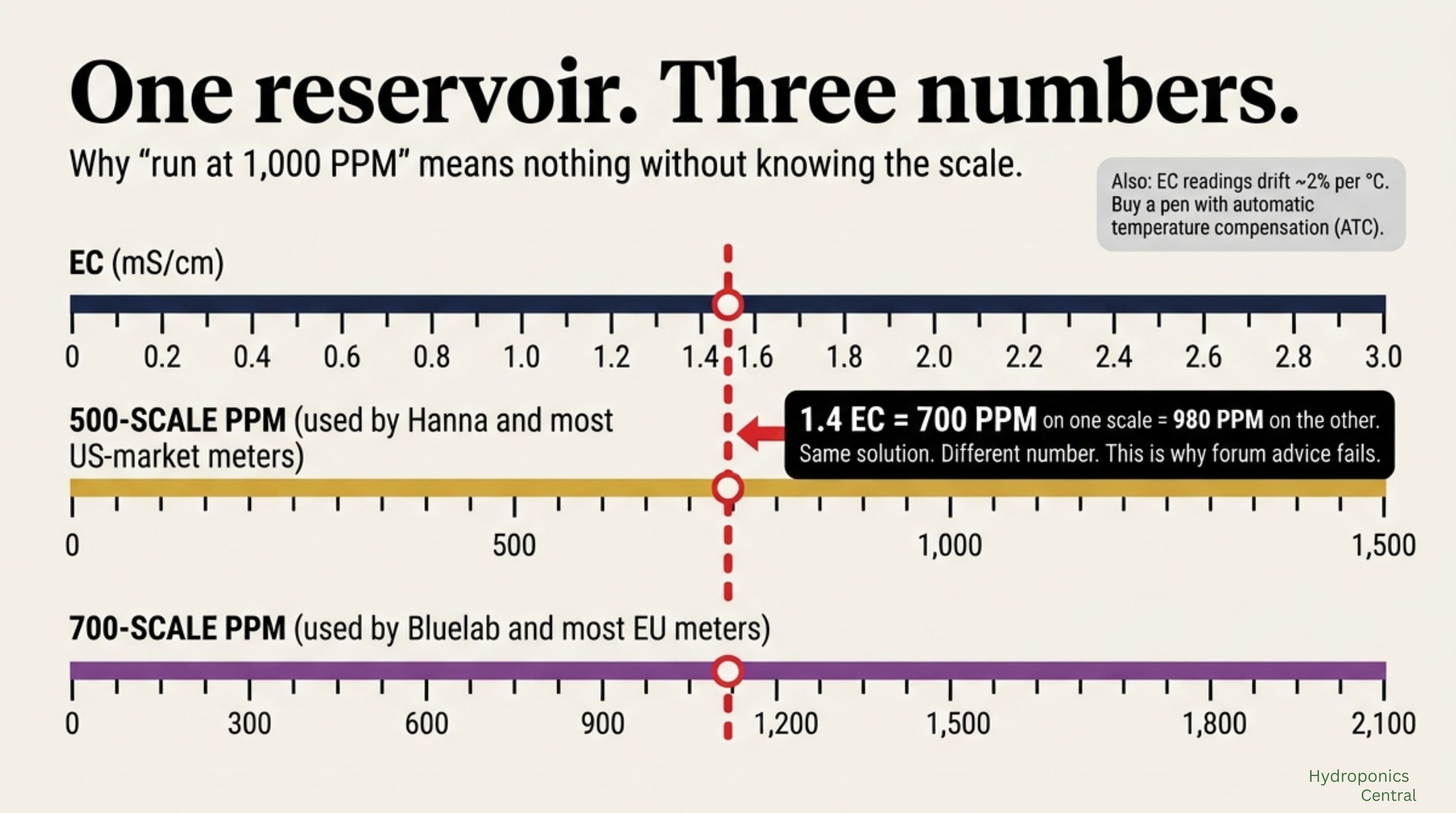
EC (electrical conductivity) measures dissolved nutrient concentration by how well the solution conducts electricity. Pure water conducts almost nothing. As mineral salts dissolve, conductivity rises. Most budget EC pens are accurate to ±0.1 mS/cm, which is fine for home growing. Just make sure the one you buy has automatic temperature compensation (ATC), because EC readings drift roughly 2% per degree Celsius. A reservoir reading 1.4 EC at 18°C reads about 1.6 EC at 28°C without ATC, and you'll chase a phantom nutrient problem all afternoon.
PPM (parts per million) is just EC converted with a factor. The two common scales are 500 (EC × 500 = PPM, used by Hanna and most US-market meters) and 700 (EC × 700 = PPM, used by Bluelab and most EU meters). Here's what nobody mentions: a Masterblend solution at EC 1.6 reads as 800 PPM on a 500-scale meter and 1,120 PPM on a 700-scale meter. Same water. Same nutrients. When a forum post says "run at 1,000 PPM," it's a useless instruction unless the scale is named. That's why every chart in this guide uses EC. It's the only scale that doesn't lie.
Target EC ranges for hydroponics by crop type:
Target EC ranges for common hydroponic crops, from seedlings through fruiting, with practical notes on where in each range to sit.
These ranges align with Penn State Extension's hydroponic crop nutrition fact sheets and are starting points. Adjust 0.1–0.2 in either direction based on how your specific plants respond.
Interpreting EC drift between top-ups: rising EC means plants are consuming more water than nutrients (top up with plain pH-adjusted water). Falling EC means they're feeding heavily (top up with working-concentration nutrient solution). Steady EC with falling water level is the ideal. That's a plant drinking and eating proportionally.
Tap water vs RO water for hydroponics
Tap water is fine for hydroponics if it reads below 0.3 EC and you let the chlorine dissipate overnight. That covers most municipal water in the US and EU. Switch to reverse-osmosis (RO) water only if your tap reads above 0.5 EC, if you're growing fruiting crops that demand exact nutrient ratios, or if you're on well water with unknown mineral content. Every nutrient recipe assumes a near-zero starting EC. Real tap water rarely is. Most city tap reads 0.1–0.4 EC, hard-water regions can hit 0.6+, and well water is anyone's guess. That starting EC counts toward your target. A Masterblend solution mixed to 1.4 EC in 0.4 EC tap water is really delivering only 1.0 EC of your nutrients, with the rest being whatever was already in the tap (often calcium and bicarbonates that raise pH and slowly throw the ratio off).
The decision tree:
- Tap water under 0.3 EC and stable seasonally: use tap water. Run it through a carbon filter ($25–$40) first if it's chlorinated. Chlorine and chloramine both suppress beneficial Bacillus bacteria if you ever add Hydroguard.
- Tap water 0.3–0.5 EC or seasonally variable: measure starting EC, subtract from your target, then mix accordingly. Acceptable for herbs and lettuce, marginal for fruiting crops.
- Tap water above 0.5 EC, hard well water, or you want predictable baselines: invest in a small RO unit ($80–$200 for a countertop model). RO gives you a near-zero starting point every time, and over a year of growing it pays for itself in saved nutrient and avoided crop loss.
Let any tap water sit out overnight before mixing. That lets dissolved chlorine off-gas. Chloramine doesn't off-gas, so for that you need a carbon filter or a Vitamin C neutraliser.
How to mix your first nutrient solution
A correct mix takes about five minutes and tracks two numbers: EC for concentration and pH for nutrient availability. Add all nutrients before checking pH. Nutrients shift water pH, so adjusting first means adjusting twice.
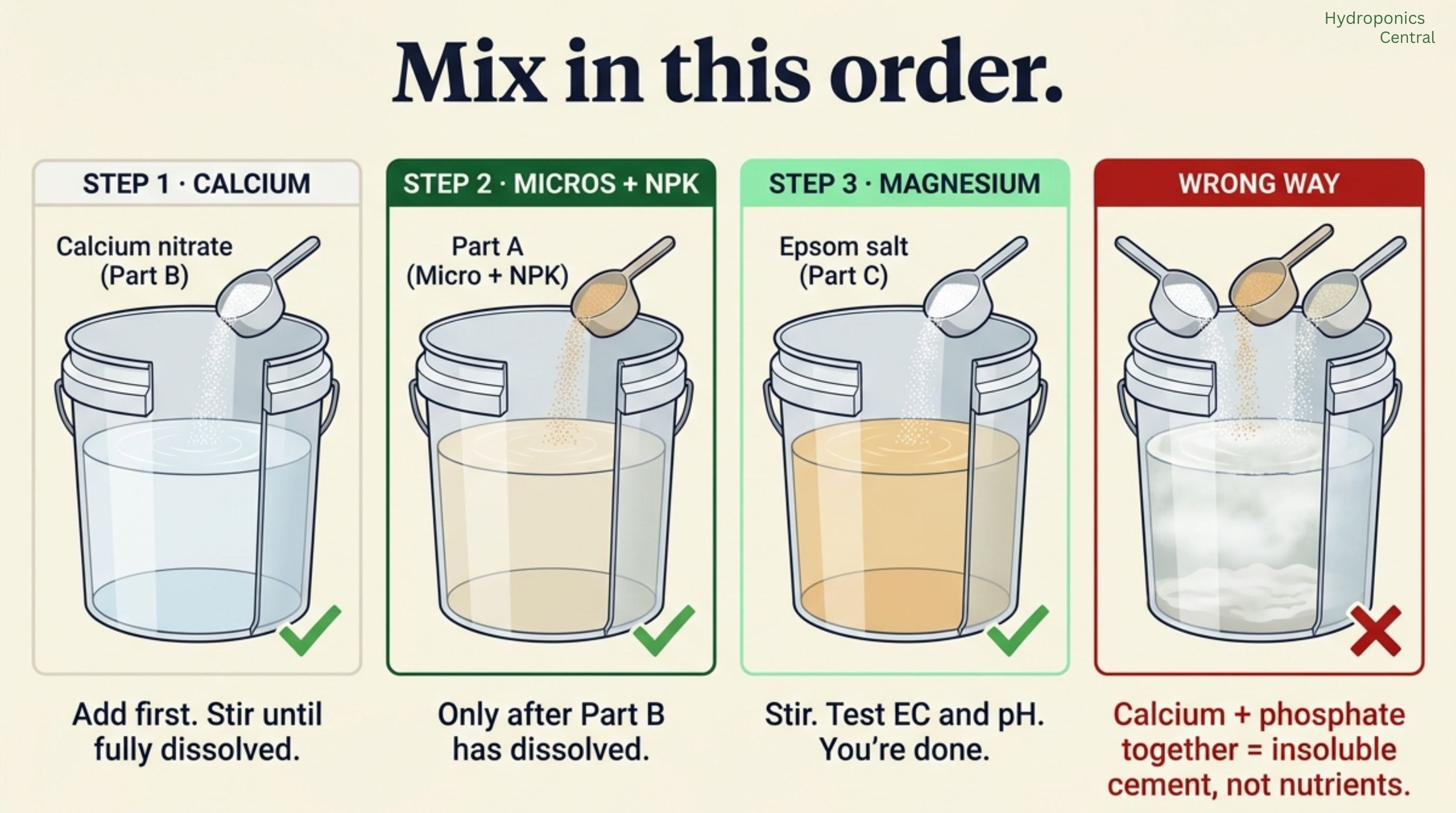
What you need:
- Nutrient product (powder or liquid)
- EC/TDS pen with ATC ($15–$30)
- Digital pH meter ($50–$80). Strips aren't accurate enough.
- pH Down (phosphoric acid, $10–$15) and pH Up (potassium hydroxide, $10–$15)
- Digital kitchen scale (0.1g resolution) for powder nutrients
Step-by-step:
- 1 Measure your source water's starting EC. Subtract it from your target EC. The difference is what your nutrients actually need to deliver.
- 2 Add nutrients in order. Masterblend: 4-18-38 first, then Epsom salt, then calcium nitrate last. Jack's 321: Part A, then Epsom, then Part B last. Flora Series: Micro, then Gro, then Bloom. Fully dissolve each before the next goes in.
- 3 Verify EC against your target. Top up with concentrate or dilute with plain water.
- 4 Check and adjust pH to 5.5–6.5 (6.0 is the safe default). Add pH Up or pH Down in 1ml increments, stir, wait 15 minutes, retest.
- 5 Recheck EC. Phosphoric acid in pH Down adds a small amount of conductivity.
- 6 Fill the reservoir and record starting EC and pH. The next reading in 48 hours is meaningless without a baseline.
Nutrient schedule basics
For herbs and lettuce, run one concentration from seedling to harvest. Use MaxiGro or your standard Jack's/Masterblend ratio. Stage-shifting buys you nothing on a four-week basil crop.
For fruiting crops, shift the N:P:K ratio across three phases:
- Vegetative (seedling to first flowers): higher nitrogen, moderate P and K. MaxiGro, or Flora Series at a veg-heavy ratio.
- Transition (first buds to first fruit set): drop nitrogen, raise P and K. MaxiBloom, or Flora adjusted bloomward.
- Fruiting (active fruit development): low nitrogen, high P and K. Push the upper end of your crop's EC range.
Common nutrient mistakes
Most beginner nutrient problems aren't product failures. They're process failures.
Mixing dry components in the wrong order. Calcium nitrate goes last. Always. Combining it with undissolved phosphate or sulfate compounds causes precipitation, dropping calcium and phosphorus out of solution as white sludge. Fully dissolve each salt before adding the next.
Adjusting pH before adding nutrients. Nutrients shift water pH. Adjust pH first, add nutrients, and you'll adjust again. Always mix nutrients first, then pH.
Not changing the reservoir. After two weeks of top-ups, the reservoir holds whatever plants didn't eat. That's an imbalanced leftover, not a complete solution. Full change every 7–14 days.
Overfeeding seedlings. Germinating into a 2.0+ EC reservoir causes burn from day one. Start seedlings at 0.5–0.8 EC and ramp up gradually.
Assuming more nutrients means faster growth. Beyond optimal EC, excess salts pull water out of roots osmotically. Follow your crop's target range and resist the urge to add another scoop.
My take as a curator
The choice narrows fast. Use MaxiGro if you want a single product and maximum simplicity. Use Jack's 321 or Masterblend if you want the lowest long-term cost and will follow the mixing order. Use Flora Series if you're running fruiting crops and want stage-specific control. Skip Fox Farm Trio for a first system. The price gap over Jack's or Masterblend is real, and the plant-performance gap isn't.
Start with the product you'll actually use consistently. A beginner mixing MaxiGro correctly every week beats one mixing Masterblend wrong half the time. Lock in EC and pH first. Once those two numbers are stable, every other variable becomes easier to debug.
What surprised me most in the research is how much the per-gallon spread compresses into the same yield. Jack's 321 at $0.02 versus Fox Farm at roughly $0.50 produces comparable results on basil and lettuce. The premium is brand recognition and organic inputs, not meaningfully better plants.
For nutrient management to actually work, two downstream habits have to stay solved: pH stability and reservoir hygiene. Keep your pH pen calibrated and change your reservoir every 7–14 days. Those are the two habits that decide whether the nutrients you paid for ever reach your plants. They're also the two most common places beginners quietly quit.
Join 1,000+ growers getting one curated hydroponic tip every week. Subscribe to the Hydroponics Central newsletter. Free, no spam.
Key Takeaways
Quick reference summary
- 1Hydroponic plants need 17 essential elements delivered entirely through water. There is no soil to draw from. If an element isn't in your reservoir, your plant has none of it.
- 2Lowest cost per gallon: Jack's 321 and Masterblend 4-18-38 both land near $0.02–$0.07 per gallon. Easiest single-product start: General Hydroponics MaxiGro ($15–$25/lb). Most adjustable across growth stages: Flora Series 3-part liquid ($30–$50 for a quart set).
- 3Mixing order is not optional. Calcium nitrate must go in a separate stock tank from phosphates and sulfates, or it precipitates as a white sludge. Penn State Extension publishes this as the standard two-tank rule.
- 4EC (electrical conductivity) measures nutrient concentration. Most beginner crops need 0.8–2.0 EC depending on crop type. PPM is just EC converted on either a 500 or 700 scale. Check which scale your meter uses and stay consistent.
- 5Above pH 7.0, iron locks out chemically even if your EC reads correct. Always adjust pH after mixing nutrients, never before.
- 6Change your reservoir every 7–14 days. Warm, oxygen-depleted, overdue reservoirs are also the fastest route to root rot. The two problems are connected.
- 7Powder nutrients (Jack's, Masterblend, MaxiGro) have a 3–5 year sealed shelf life and cost 50–80% less per gallon than liquid equivalents. Liquid is easier to dose but costs more over time.
Frequently Asked Questions
Common questions from our readers
Written by
Carl — Hydroponics CuratorI research hydroponics so you don't have to — going through university studies, extension programs, and grower communities to find what actually works for home growers.
I'm a content curator and researcher, not a licensed agronomist or commercial grower. Everything published here is sourced from credible third-party research, which is always linked inline. When in doubt, consult your local agricultural extension office. Learn more about how I research →
Found this helpful? Share it!